
For schools
Pick one or two great books a year for a grade and give them the time they need. Each student writes in a copy and keeps it. Orders received by the end of February 2027 are delivered beginning June 2027.
“In the case of good books, the point is not to see how many of them you can get through, but rather how many can get through you—how many you can make your own.”
One great book a year
Most schools already teach a full reading list, and we would not ask you to change it. Our editions are for the one or two books a year that deserve the slowest reading. A class stays with that book for weeks. Students reread a passage until it opens up, mark the margin, and come back to a chapter with a new question.
Time for the book
Classical educators have an old word for the time this kind of reading needs. The Greeks called it scholē, and our word school comes from it. It meant leisure: time free of business, given to study and conversation. Their word for business, ascholia, is literally the lack of it.
Few school days have much of that time in them. A class that gives several weeks to one great book has made some.
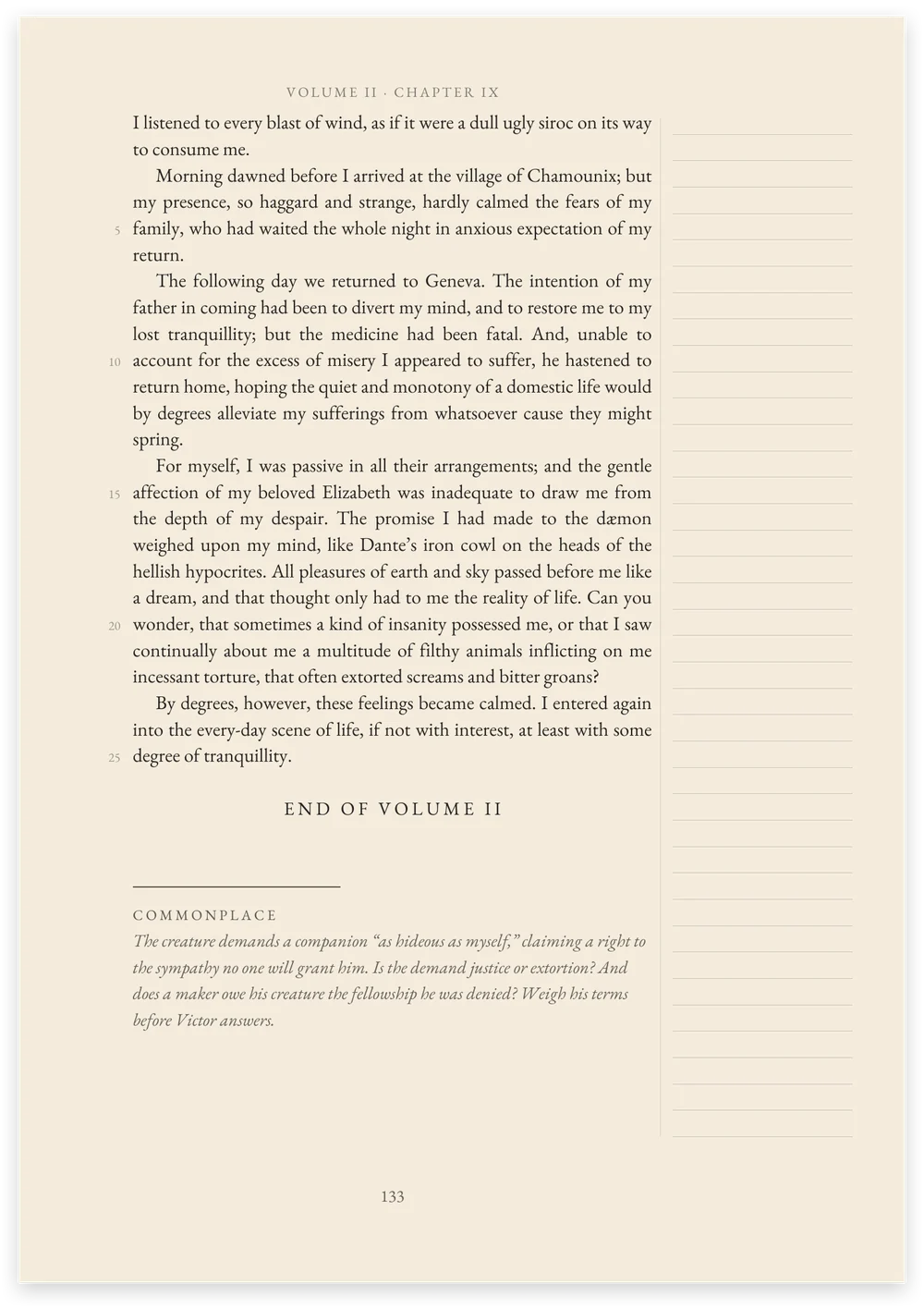
A Commonplace Edition is made for those weeks. Every fifth line is numbered, so a class can turn to the same sentence together. The outer margin is ruled and wide enough for real notes. At the close of each chapter a short prompt turns the reader back to what was just read.
Writing is part of the reading.
If your students already annotate, they will find room for it here. A student who means to write beside a passage has to read it closely enough to have something to say: a question, an objection, a definition, an example to follow or avoid, the page where the same idea came up before. The note keeps that thought on the page where it happened, ready for class the next morning and for the reader who opens the book years later.
The research agrees. Writing to Read, a 2010 review of the research by Steve Graham and Michael Hebert, found that writing about a text helped students understand it more than reading it, rereading it, discussing it or receiving reading instruction.
A list that fits your school
Reading lists differ from school to school, and they should. David Diener, a former headmaster who now teaches education at Hillsdale College, calls the question of which great books to teach “practical and particular.” In Classis, a journal of classical Christian education, he sets out five things a school should weigh, and all five start with the school.
Your mission
A reading list should serve what the school is for. Diener tells of a school whose lists grew each year until teachers had to hurry students through them, against the school’s own aim of forming lifelong learners. A school that prizes depth may read fewer books, and read them slowly.
Your time
There are more great books than hours to teach them. Count the days in your week, the minutes given to literature and the homework you assign, since most reading happens at home. Then choose the books most worth that time.
Your students
Where students live and what they bring from home can change which books suit them, and when. A class from churchgoing families, Diener notes, may be ready for The Pilgrim’s Progress at an earlier grade than a class from mostly non-Christian homes.
Your teachers
A list should hang together from grade to grade, so teachers cannot simply teach what they like. Still, a teacher’s strengths count. When two books would serve equally well, let the teacher choose: the one who wrote a thesis on Dostoevsky should probably teach Crime and Punishment.
Your sequence
The order of your history and literature courses decides what each grade is ready for. A school that last studies Greece in eighth grade may find some Greek works too heavy for that year. One that saves American literature for twelfth grade has students reading Twain after Dante and Milton, the harder books first.
Our catalog holds sixty-three titles, from Heidi and The Jungle Book to The Republic and The Brothers Karamazov. Each lists the grades where schools most often read it. Treat that as a guide, and place each book where your students and your sequence need it. Since every title is made to the same specification, you can choose on the book alone.
David Diener, “The Practical and Particular Nature of the ‘Canon’ Question,” Classis, 2025.
A class set for each book you choose.
Choose a title
Choose a title for a grade from the catalog, or one for each grade you teach.
Ask for a quote
Tell us the grade and about how many students will read it, and we will send a quote.
Order by February
Order by the end of February 2027. Copies are delivered beginning June 2027, before the school year opens.
Students keep them
Each student writes in a copy and keeps it. Next year’s class gets copies of its own.
A copy a student can write in and keep.
Most classroom classics are inexpensive paperbacks, and for many books that is the right choice. A Commonplace Edition is for the book a student writes in all year, takes home, and may open again years later. It is sewn so it opens well for note taking, and the paper is heavy enough to write on.
Three ways to teach a book
In his Classis essay “How Do Books Work in Our Classrooms?” Chris Schlect, head of humanities at New Saint Andrews College, describes three. A teacher can bring a book to life in a reading the class learns to imitate, take its arguments apart, or hold up its people as examples to follow or avoid. Ask first why the book was chosen, he advises, and teach it toward that end. Our page is made to serve all three.
Numbered lines
“Page 132, line 15” brings the whole class to the same sentence.
A ruled margin
Room on every page for a student’s own marks, questions and cross-references.
Prompts that stay inside the book
Each prompt starts from something in the chapter, asks a question the text can answer more than one way, and gives the student something small to do in the margin.
The author’s text
Unabridged and unmodernized, in named translations: Butler’s Homer, Mackail’s Virgil, Garnett’s Dostoevsky. Where an edition is a selection or leaves something out, its page says so.
The prompt printed at the close of Volume II of Frankenstein:
Commonplace
The creature demands a companion “as hideous as myself,” claiming a right to the sympathy no one will grant him. Is the demand justice or extortion? And does a maker owe his creature the fellowship he was denied? Weigh his terms before Victor answers.
Questions schools ask
Do students really write in these books?
Yes. The margin is ruled for it, and the paper is a heavy cream stock at 120 gsm that takes pencil and pen without the ink bleeding through. The books are the students’ to keep.
Do we have to follow a sequence?
No. Choose any title for any grade. The grades in the catalog show where schools most often read each book, as a guide.
Can we start with one title?
Yes. A school can begin with one book in one grade. Because each class buys its own copies, you can add titles as you go.
When can we have copies?
Delivery begins June 2027, in time for the school year that opens that fall. Orders are due by the end of February 2027.
Can we see a copy first?
Yes. We send a review copy of Frankenstein to any school that asks.
Are the texts complete?
Yes, unless a title’s page says otherwise. A few are selections by design, such as Plutarch’s Lives (twelve Lives) and The Pilgrim’s Progress (Part One), and each title’s page says what its edition contains.
Is this only for classical schools?
No. The catalog grew from the reading lists of 28 classical schools and homeschool programs, and any school that teaches these books can use them, one title or many.
Where are the books made?
Every title is designed and typeset in Sagamore Hills, Ohio. The first printing of Frankenstein was printed and bound in China.
Tell us about your school.
Ask for a review copy of Frankenstein for your department. If you know the first title you would teach, tell us the grade and roughly how many students will read it, and we will reply with a quote.
Or join the list
One note before the February order deadline, and another when a new title joins the catalog.